


Back in My Day…

by Brett Cope, Product Advisor
...5 Violet Features That Make Engineering [Almost] Too Easy
In 2007 I launched my professional engineering career in the world of Big Aerospace. Bright-eyed and excited, I was blown away by the awesome hardware we were building.
Just as mind-blowing were the antiquated ways we were doing it.
To paint the picture, here are some things I did regularly at that time:
- Carried physical drawings all over the campus, chasing down signatures in “blue ink” to release them
- Used CADDS 5, a CAD program based on a command prompt
- Witnessed senior engineers making revisions using a hobby knife, the copy machine, and a glue stick.
Yes people, this was analogue Ctrl+X, Ctrl+C, and Ctrl+V.
While this is starting to sound like a story that includes walking uphill barefoot in the snow both ways, the shockingly outdated practice I’ll be talking about is still all too common.
One of the most ubiquitous means of doing any analysis in this world comes in the form of an uncontrolled, altogether unreadable spreadsheet of unknown origin. These files are usually shared via e-mail attachment and have long sat dusty on the local hard drives of the engineers who use them. There are hundreds of different versions flying around the world, with slight changes, different assumptions, and questionable sources of data. More often than not, the values therein have no units, no source, and if you want to know how to repeat them, you have to click on a cell and work backwards through the mess of equations that generated the value within it.
And the reality was that this was the best case scenario. At least it was reusable and easy to share. More often than the dusty spreadsheet we had analyses that were done in a notebook with a #2 pencil and a calculator, drawing on the knowledge of staple textbooks like Shigley or Roark’s.
In both cases, the math was likely sound, but the inputs and assumptions were questionable at best. Some of us simply used the values that were already in the spreadsheet from last time. Those of us who were more diligent tried calling the experts in various domains and getting a better answer. But even in that case, those assumptions have conservatism, bias, and potentially unfamiliarity with the use case baked into them, as well.
Flash forward to modern times. Violet Labs has entered the chat. I work with them because I deeply wish I’d had this functionality available to me in those early days, saving me time, sanity, and probably years off my life.
Let’s look at 5 of my favorites:
Scripts
All the math is no longer on a sheet of graph paper or your cluttered desktop. With scripts, you can make public (or private) live analyses using Python, Julia, or even Matlab. All without ever requesting access to a software license from your stingy IT department.
Parameters
What good is that script if I still have to guess what all of the inputs are? You can link your inputs to a parameter set associated with your program and have the designated experts maintain those values with the latest and greatest data.
Want a sandbox? Just make your own parameter set to tweak the values and experiment, then link them with the official set later.
Requirements
When it’s time to compare the outputs of your analysis to a requirement and find out if it’s “good enough”, you have to go hunt through a pile of documents and look for a stale screenshot that probably isn’t up to date either, right? Wrong. No, thank you. Not my idea of a good time.
Instead, you can have your parameters linked directly to the requirement in Violet. It’s there and it’s live. No hunting required.
Entities
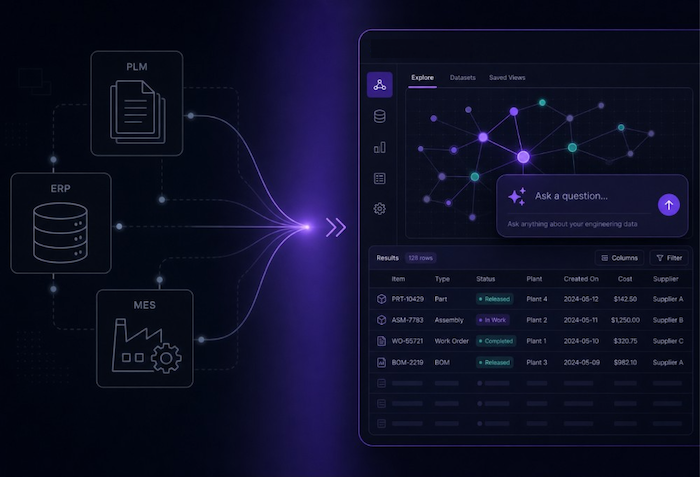
The parts, assemblies, etc. subject to your analyses all have a unique entity in Violet. It’s fast and simple to search in a fully indexed database via name, part number, or maneuvering up and down in an assembly tree. Ahhhh…sweet, sweet logical organization!
Relationships
So the above sounds like an awful lot of connectivity that’s a mess to keep track of, right? Nope.
With the click of a button, you can view a relationship graph that shows how entities, requirements, and parameters all tie together. This is the “digital thread” you keep hearing about without the heavy sigh that comes after a buzzword with no backbone. It’s actually here, and it actually works.
Looking back, I can only imagine how many forehead-shaped dents in my desk I could’ve avoided with a tool like Violet. It’s not magic, but it’s the kind of progress that lets engineers spend less time chasing ghosts in spreadsheets and more time actually engineering. And that’s all I ever wanted.
Interested in testing Violet out for yourself? Request a no-pressure demo here.


Abolish silos.

