


Why ERP-Centric Workflows Break Down in Modern Manufacturing

For many manufacturers, the ERP system has become the operational center of gravity. Systems like NetSuite, Odoo and SAP Business One manage purchasing, inventory, work orders, vendors, and production-related transactions across the business.
But modern manufacturing workflows rarely begin and end inside the ERP.
Engineering data lives in CAD, PLM, requirements management, test systems, supplier portals, spreadsheets, and custom applications. Production data flows through MES platforms, quality data lives in QMS systems, and procurement signals come from RFQ or procure-to-pay tools.
The result is fragmented operational execution. Unsynchronized systems means your team risks running out of inventory or inadvertently purchasing excess inventory, delaying delivery or adding unplanned upfront costs. Team time and effort is spent understanding the true demand.
A Unified Operational Layer
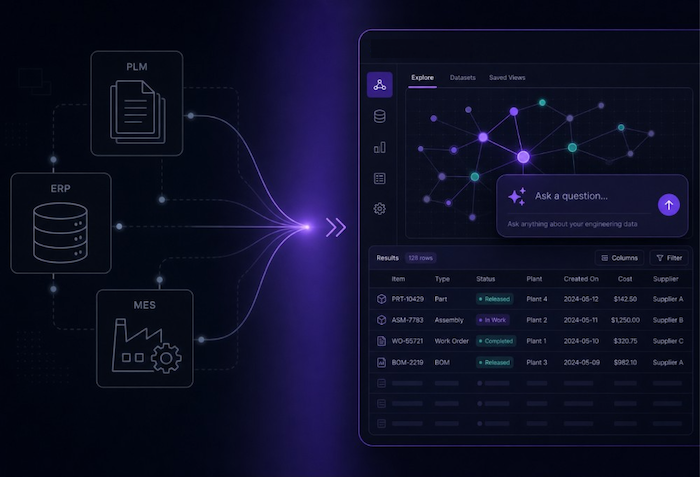
Violet solves this with a structured operational layer that lives across the manufacturing stack. Violet fetches data from multiple applications, enables intelligent reporting and analytics, and can synchronize information to multiple destinations.
Your ERP becomes one connected node within a broader ecosystem of engineering and production systems.
Violet ensures your part and BOM data are consistently available and up to date in your procurement system, ERP, and MES; part inventory is tracked from receiving to delivery across ERP and MES; and the workflows used to achieve data consistency are adaptable to evolving business processes or tool migrations.
At the core of the platform are three foundational capabilities:
- A manufacturing-native ontology that streamlines data mapping and eliminates translation burden
- A hub-and-spoke architecture that allows data to flow traceably between multiple systems
- A powerful data ingestion and synchronization framework
Together, these enable reliable, observable, and highly flexible cross-system workflows.
Why the Ontology is the Differentiator
Every system represents manufacturing data differently.
A part in NetSuite may not map cleanly to a part in Manufacturo. A manufacturing order may reference different identifiers across systems. BOM structures, revisions, routings, inventory states, vendors, and serial tracking all vary depending on the application and user context.
Most integrations solve this with rigid field mappings. If you want to change your mappings, you need to go back to the integration provider and pay for updates.
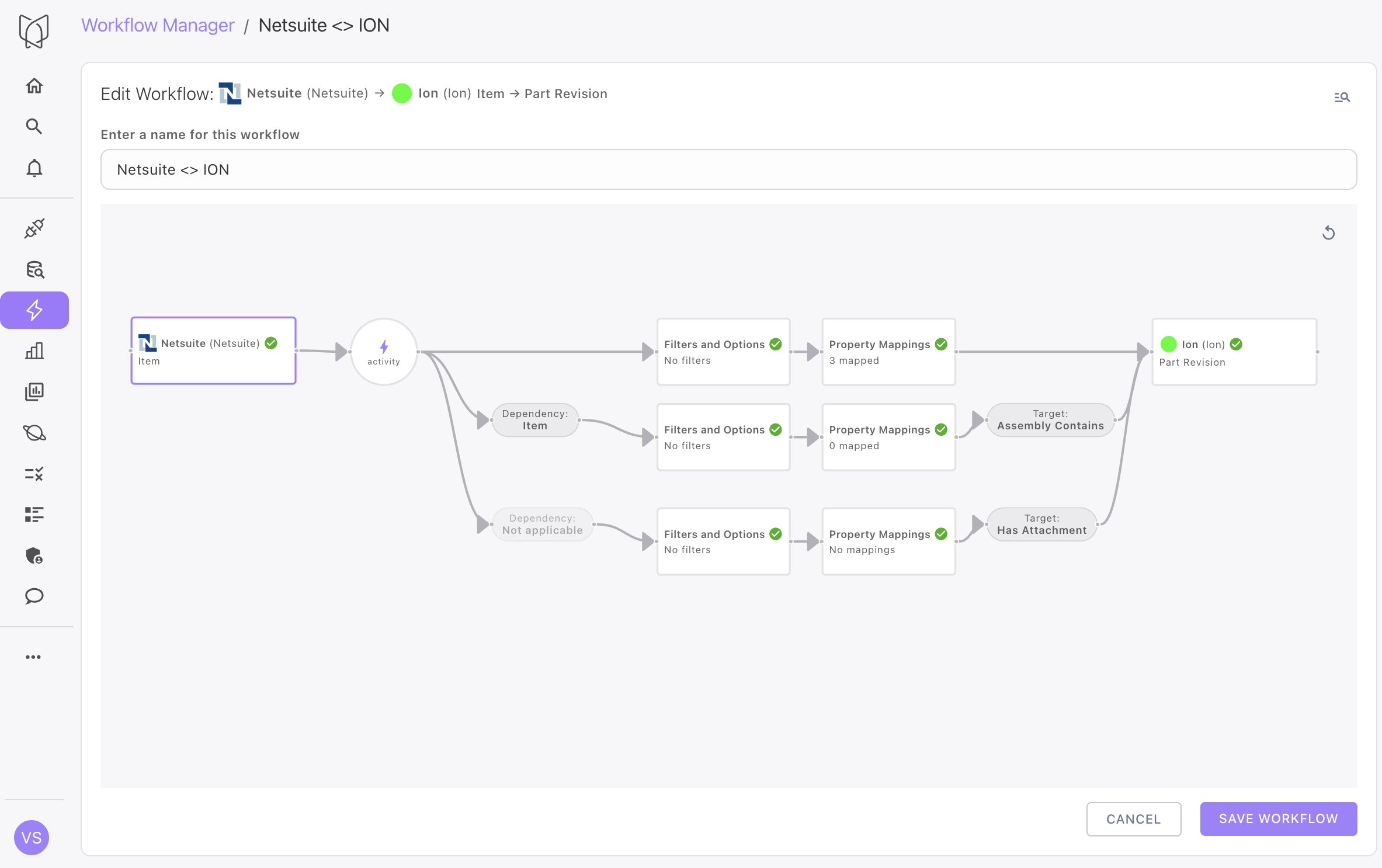
Violet provides a structured ontology layer that normalizes entities, attributes, relationships and operational semantics across systems. End users can then configure their mapping against the unified Violet ontology, implementing updates as necessary in a low-code/no-code interface.
This creates a shared operational model spanning the product development and delivery lifecycle.
The data doesn't move from system to system. The meaning does.
Rather than hardcoding workflows around individual APIs, workflows operate against a consistent semantic layer. This enables immediate ERP ↔ MES synchronization for a team’s given stack, and is easily adaptable to new tools or business logic as a team grows.
Using this framework, Violet can:
- Drive a released manufacturing order in NetSuite to automatically trigger the related concepts in downstream MES workflows, like run creation or kit allocation
- Reconcile inventory movements in MES back into ERP in near real-time, clearly translating transactions across supply chain and manufacturing domains
- Propagate part revisions and BOM changes across systems while maintaining lineage and traceability across “the thing we sell” and “the thing we build”
Because the ontology preserves relationships between entities, workflows remain resilient even as individual source systems evolve.
Hub-and-Spoke vs. Point-to-Point
Over time, the typical manufacturing organization will accumulate dozens of brittle, point-to-point integrations to achieve data exchange.
ERP connects directly to MES. MES connects directly to PLM. PLM connects to procurement systems. Each workflow introduces custom logic, duplicated mappings, and operational fragility.
The architecture does not scale. Third party integration providers likely only offer one integration along the chain and lack the business context in the other links. In-house development teams must learn the intricacies of each API, monitor for updates, and maintain connectivity as things evolve.
Instead, Violet provides a hub-and-spoke model: Each external system integrates once into the Violet platform. Violet then manages orchestration, transformation, synchronization, and workflow execution centrally, coordinating consistent data delivery to multiple destinations.

🧩 Reduced Integration Complexity
Instead of maintaining N² system-to-system integrations, organizations maintain a single integration layer: connect to Violet.
Adding a new MES, PLM, or supplier system becomes dramatically simpler.
Once an application is integrated to Violet, that data can be joined with existing data from all other integrated tools. For example, because you synchronized purchase orders (containing vendor information) to your MES to help enable receiving, your MES already knows about vendors and can help you monitor nonconformance trends across different suppliers.
Nonconformance enablement comes “for free.”
📋 Centralized Governance
Transformation logic, business rules, mappings, and operational workflows are managed centrally instead of being duplicated across multiple integration paths. View and adapt the aggregated business logic across multiple applications in one place.
⚡Higher Performance
The architecture enables optimized ingestion pipelines, asynchronous processing, scalable synchronization patterns, and efficient event propagation across systems.
🔀 Operational Flexibility
Workflows can evolve independently of the underlying source systems.
This is critical in manufacturing environments where operational processes change continuously. Startups can readily evolve their workflows as their processes mature or the business grows into more richly-featured applications; mature organizations can accommodate diverse product line or business unit-specific processes.
Auditable, Observable Workflows
Manufacturing operations require traceability - full stop.
When data moves between ERP, MES, PLM, and production systems, organizations need to know:
- What changed
- When it changed
- Why it changed
- Which workflow triggered the action
- Which systems were involved
- Whether synchronization succeeded or failed
Violet is designed with observability and auditability as first-class platform capabilities.
The platform provides visibility into:
- Data lineage
- Workflow execution history
- Synchronization state
- Event processing
- Transformation logic
- Entity relationships and dependencies
- Retry and failure states
- Cross-system traceability
This is critical in regulated, high-compliance manufacturing environments where operational accountability matters - whether in aerospace & defense, nuclear energy, or medical technology.
Rather than treating integrations as opaque middleware, Violet exposes them as observable operational infrastructure.
Enabling the Next Generation of Manufacturing Workflows
The future of manufacturing operations is not isolated software systems.
It is coordinated, intelligent workflows operating across the entire engineering and production stack.
ERP systems remain critical systems of record. MES platforms provide operational execution. PLM and engineering systems manage product definition.
But your company’s competitive advantage increasingly comes from how effectively those systems work together - and align to the way your team really works.
Violet provides the operational foundation that enables that coordination:
- A shared ontology purpose-built for manufacturing data
- Hybrid ingestion pipelines (scheduled and event-driven)
- Configurable synchronization
- Centralized orchestration
- Observable, auditable workflows
- Scalable hub-and-spoke integrations
The result is a manufacturing stack that is more connected, more resilient, and significantly more adaptable to modern engineering and production demands.
See it live with your data
We'll connect to your NetSuite sandbox and your MES in a single session and show you what Violet surfaces - no prep required on your end. Book a demo here.


Abolish silos.

